Perceptual Map Presentation Template
Perceptual Map Template for PowerPoint & Google Slides
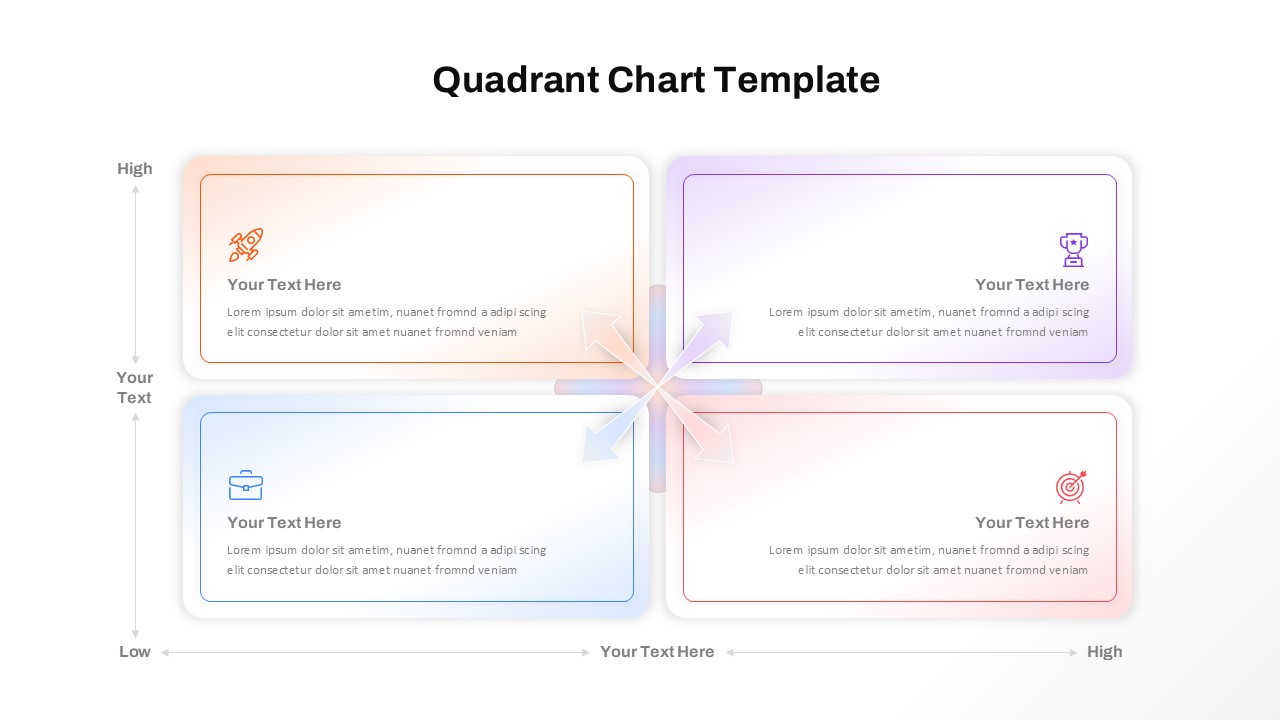
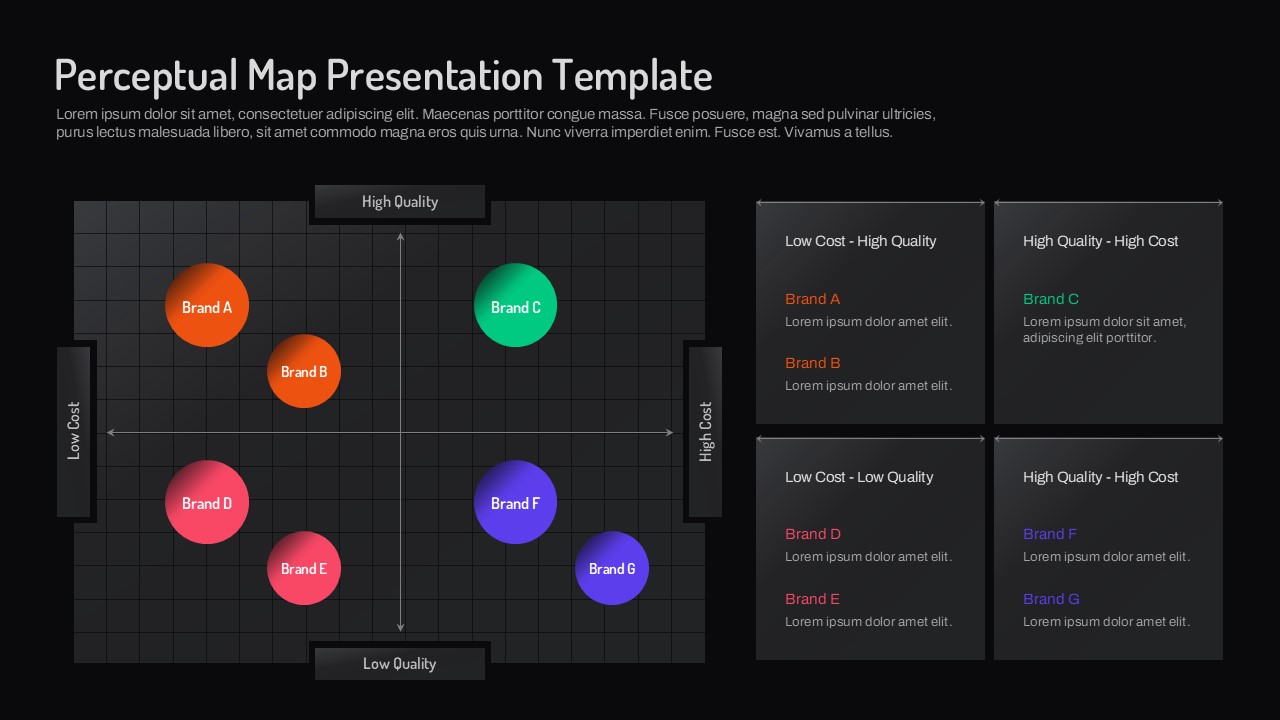
The Perceptual Map Presentation Template is a professional and visually engaging tool for comparing brands, products, or services based on two key dimensions, such as quality and cost. Designed for PowerPoint and Google Slides, this template helps marketing teams, business consultants, product managers, and strategists present competitive positioning in a clear and easy-to-understand format. The main perceptual map uses a four-quadrant layout to show where different brands sit in relation to quality and cost. This makes it simple to identify market positions, compare competitors, and discover potential gaps or opportunities.
The template also includes supporting sections that group brands into categories such as low cost–high quality, high quality–high cost, low cost–low quality, and high cost–low quality. These areas provide additional space to explain each brand and support the visual analysis with short insights. The dark background and contrasting colored markers create a strong presentation style while keeping the map easy to follow. You can replace the sample brand names, descriptions, and positioning criteria with your own market data. The editable layout also makes it suitable for different industries and research topics.
- Perceptual Map: Compare brands using quality and cost dimensions.
- Four-Quadrant Analysis: Highlight different competitive positioning areas.
- Brand Comparison: Display multiple brands on one visual map.
- Market Positioning: Identify competitive strengths and market gaps.
- Supporting Details: Add short descriptions for each brand category.
- Editable Design: Customize labels, colors, data, and content easily.
- PowerPoint Compatible: Edit and present the template using Microsoft PowerPoint.
- Google Slides Compatible: Collaborate and customize the presentation online.
This Perceptual Map Presentation Template is useful for competitive analysis, market research, brand strategy, and product positioning. It helps turn complex market comparisons into a simple visual story that audiences can understand quickly. Use it for strategy meetings, marketing presentations, consulting reports, business proposals, or classroom discussions where clear competitive positioning is important.
See more

Aspect Ratio
16:9Item ID
SKT04718


FAQs
You May Also Like These Presentation Templates


- Free
- Free


- Free