
Best SWOT Analysis Templates for Business Strategy Planning
Business strategy planning requires clear frameworks for evaluating where you stand and where you should go. Among all strategic tools, SWOT analysis remains one of the most widely used because it’s simple, practical, and forces structured thinking about both internal capabilities and external conditions.
But most SWOT analyses fail to deliver useful insights. They become lists of generic observations rather than focused strategic assessments. The format matters as much as the thinking. A well-structured SWOT analysis template guides clearer thinking, produces more actionable insights, and communicates strategic position more effectively than ad hoc approaches.
This guide explains what makes SWOT analysis templates effective, how to choose formats for different business contexts, common mistakes that undermine strategic value, and where to create SWOT analysis slides that actually support decision-making.
What a SWOT Analysis Template Includes
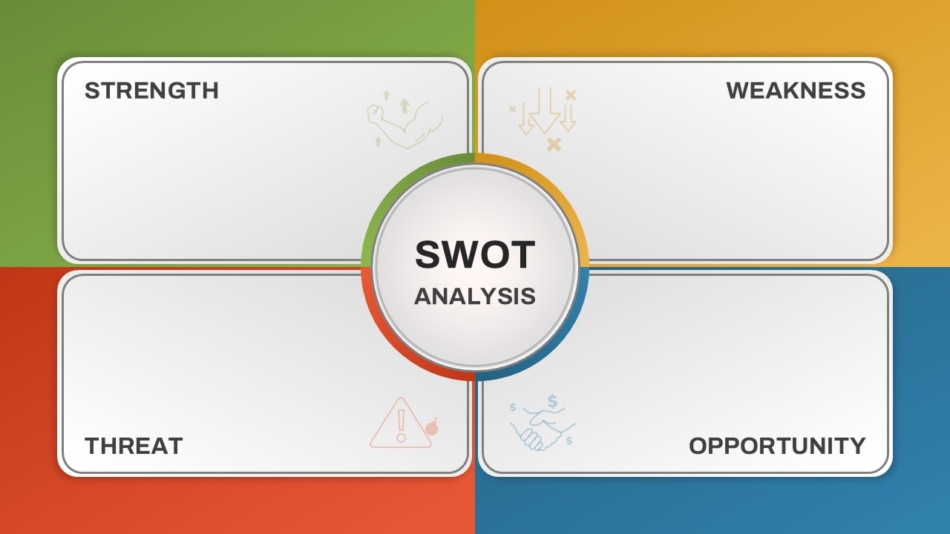
A SWOT analysis template provides a structured four-quadrant format for organizing strategic assessment. Each quadrant captures one dimension of strategic position.
Strengths occupy one quadrant, documenting internal capabilities and advantages. These are things the organization does well, resources it possesses, or competitive advantages it holds. Strengths should be specific and significant rather than generic descriptions that could apply to any company.
Weaknesses occupy the second quadrant, acknowledging internal limitations and vulnerabilities. These are capability gaps, resource constraints, operational inefficiencies, or competitive disadvantages. Honest weakness assessment prevents overcommitting to strategies the organization can’t actually execute.
Opportunities occupy the third quadrant, identifying favorable external conditions the organization might exploit. Market trends, regulatory changes, competitor vulnerabilities, technological developments, or unmet customer needs all represent potential opportunities. The key is external factors beyond direct organizational control.
Threats occupy the fourth quadrant, documenting external risks that could harm performance. Competitive pressure, market disruption, regulatory restrictions, economic conditions, or changing customer preferences all constitute threats. Like opportunities, threats are external factors the organization must respond to rather than directly control.
The template structure matters because it enforces the critical distinction between internal factors (strengths and weaknesses) and external factors (opportunities and threats). This distinction shapes strategic thinking. Strategies should leverage strengths to exploit opportunities, address weaknesses that prevent capturing opportunities, use strengths to mitigate threats, or shore up weaknesses that make threats particularly dangerous.
How to Use SWOT for Business Strategy Planning
SWOT analysis serves multiple strategic planning purposes, each requiring slightly different approaches.
Initial Situation Assessment
At the start of planning cycles, SWOT provides comprehensive situational understanding. Teams document where the business stands before deciding where it should go. This baseline assessment surfaces assumptions, identifies areas of agreement and disagreement, and creates shared understanding across leadership.
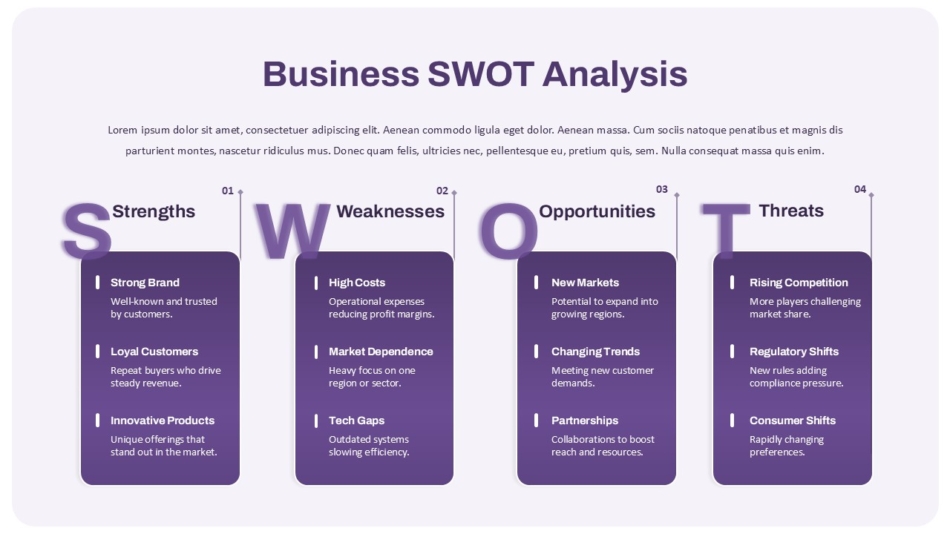
For this purpose, business SWOT analysis PowerPoint templates provide clean, professional formats appropriate for leadership discussions where credibility and clarity matter.
Market or Product Evaluation
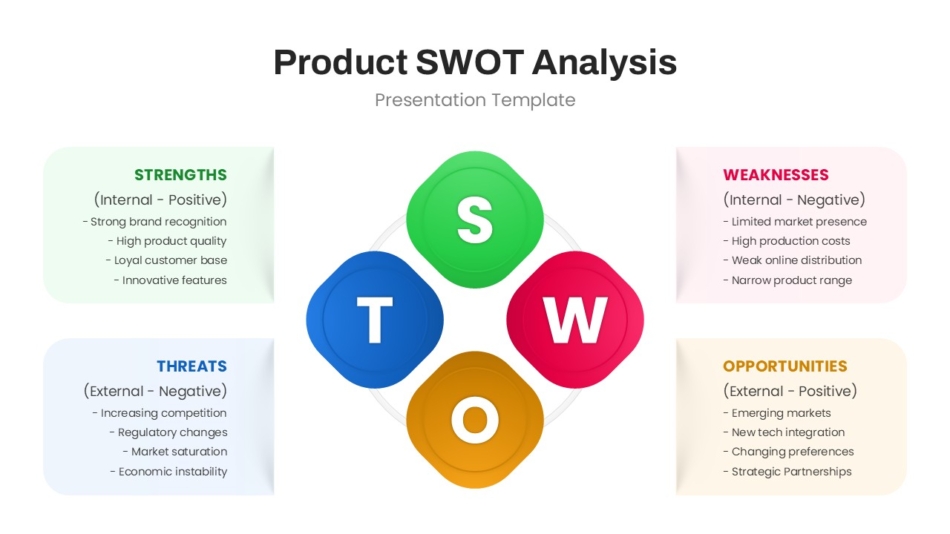
When evaluating specific markets, products, or business units, focused SWOT analysis assesses opportunities and risks in that particular context. A product SWOT analysis template structures this product-specific assessment clearly.
Product SWOT differs from company-wide SWOT by focusing on product-specific capabilities (strengths), product limitations (weaknesses), market opportunities for this product, and competitive or market threats to product success.
Strategy Development and Validation
During strategy development, SWOT helps generate strategic options. Ask what strategies would leverage strengths to capture opportunities. What would address weaknesses preventing opportunity capture? How could strengths mitigate threats? Which weaknesses make threats particularly dangerous and deserve immediate attention?
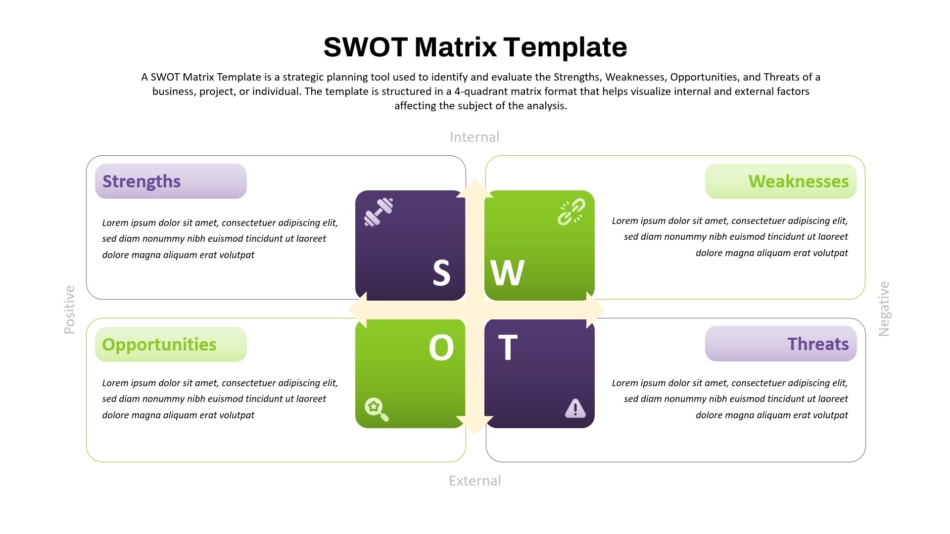
This generative use of SWOT transforms it from passive assessment to an active strategy creation tool. A SWOT matrix PowerPoint template can include strategy generation alongside traditional SWOT quadrants.
Competitive Analysis
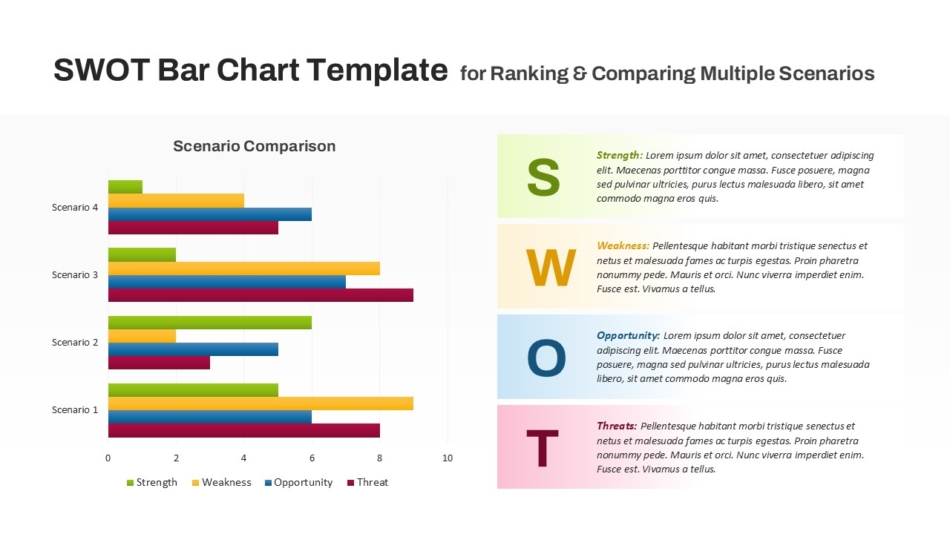
When analyzing competitive positions, SWOT helps structure relative assessment. Your strengths compared to competitors, your weaknesses relative to their capabilities, opportunities you’re better positioned to capture, and threats they’re better positioned to weather all inform competitive strategy.
For this comparative use, formats that allow side-by-side SWOT comparisons or SWOT bar charts for scenario comparison work particularly well.
Sales and Marketing Strategy
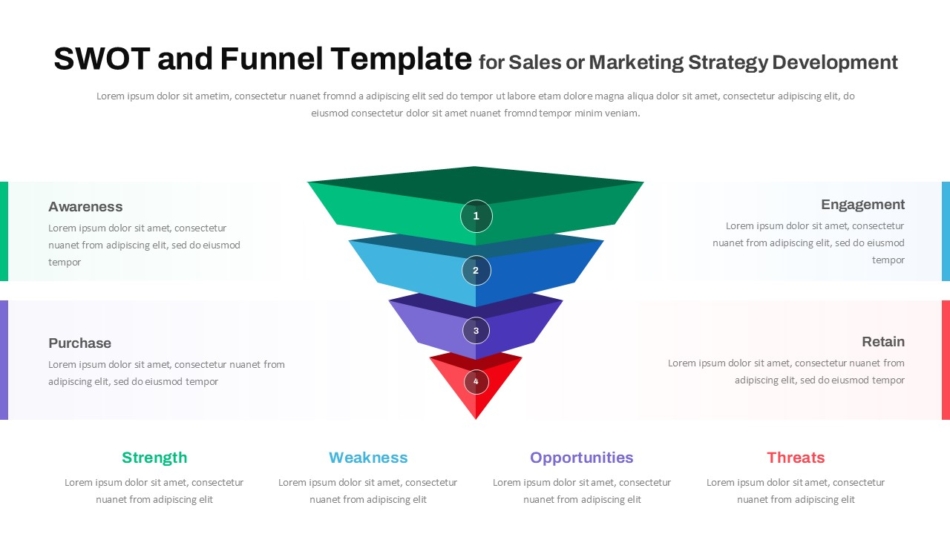
Sales and marketing planning benefits from SWOT that connects strategic assessment to funnel thinking. Understanding strengths and weaknesses in conversion capability alongside market opportunities and competitive threats shapes go-to-market strategy.
A funnel and SWOT template for sales or marketing strategy development integrates these perspectives into unified strategic frameworks.
Common Mistakes in SWOT Analysis Slides
Recognizing frequent SWOT errors helps you avoid them in your strategic work.
Confusing Internal and External Factors
The most common SWOT mistake is mixing internal and external factors. Listing “market growth” as a strength when it’s actually an opportunity, or “poor customer service” as a threat when it’s actually a weakness undermines the framework’s logic.
Strengths and weaknesses must be internal attributes the organization controls. Opportunities and threats must be external conditions the organization responds to but doesn’t directly control. Maintaining this distinction keeps SWOT analysis strategically useful.
Writing Vague or Generic Points
SWOT statements like “strong team” or “competitive market” communicate nothing specific. Strong compared to what? Which competitors create which competitive pressures? Generic statements produce generic strategies.
Good SWOT points are specific enough to drive decisions. “Proprietary algorithm reduces processing time 40% below industry standard” is a strength you can build strategy around. “Good technology” is not.
Failing to Make Connections Between Quadrants
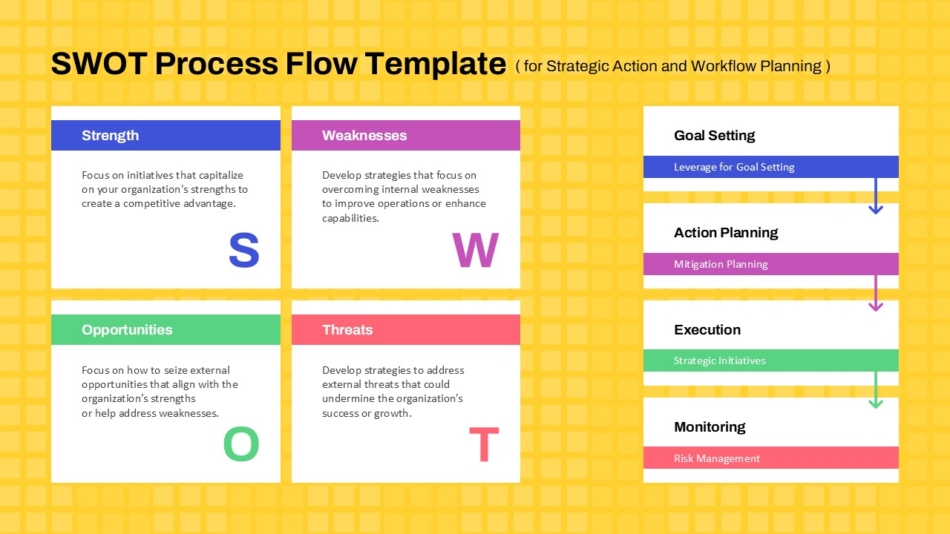
SWOT becomes strategic when you connect the quadrants. Which strengths position you to capture which opportunities? Which weaknesses prevent you from exploiting opportunities? How do strengths help mitigate threats? Which weaknesses make threats particularly dangerous?
These connections generate strategic options. Without them, SWOT remains descriptive rather than strategic. A SWOT process flow template can visualize these strategic connections explicitly.
Making SWOT a One-Time Exercise
Business conditions change. Competitors evolve. Markets shift. Technology advances. A SWOT analysis from six months ago may already be outdated.
Regular SWOT updates keep strategic understanding current. Quarterly reviews work well for most businesses. More frequent updates suit fast-moving markets. The format should support easy updates rather than requiring complete rebuilding each time.
Ignoring Evidence
SWOT points should rest on evidence rather than opinion. When listing “superior customer service” as a strength, can you cite customer satisfaction scores, retention rates, or competitive benchmarks? When noting “market consolidation” as a threat, do you have data on merger activity or market concentration?
Evidence-based SWOT withstands scrutiny and builds confidence in resulting strategies. Opinion-based SWOT invites debate that distracts from strategy development.
Where to Create a SWOT Analysis
Multiple tools and platforms support SWOT creation. The right choice depends on your workflow, collaboration needs, and presentation context.
PowerPoint and Google Slides
Most business SWOT analyses live in presentation software because strategic planning discussions happen in meetings. PowerPoint and Google Slides both handle SWOT well.
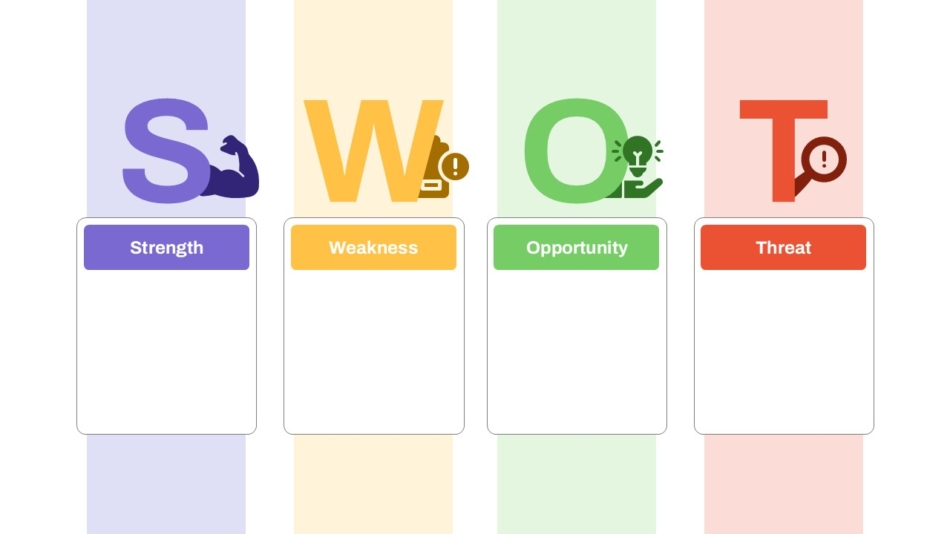
Building SWOT from basic shapes works but requires attention to alignment, spacing, and formatting. A blank SWOT analysis template or empty SWOT analysis template provides clean structure without predetermined content, giving complete flexibility while maintaining professional appearance.
Both platforms support real-time collaboration, making them practical for team-based SWOT development where multiple people contribute.
Whiteboards and Collaborative Platforms
Physical whiteboards or digital whiteboard platforms like Miro or Mural work well for initial SWOT brainstorming. The freeform nature encourages contribution and makes moving ideas between quadrants easy during discussion.
The challenge comes when translating whiteboard SWOT into presentation format for broader communication. Starting directly in presentation software avoids this translation step.
Downloadable and Editable Templates
Ready-made SWOT templates save formatting time and ensure professional appearance. SlideKit provides multiple SWOT formats for different use cases and visual preferences.
Creative SWOT analysis templates add visual interest while maintaining the clear four-quadrant structure SWOT requires. These work well when presenting to audiences who see frequent SWOT analyses and appreciate fresh visual approaches.
For situations requiring multiple SWOT perspectives or variations, a circular SWOT analysis diagram template shows how SWOT quadrants connect and influence each other, making strategic relationships more visible.
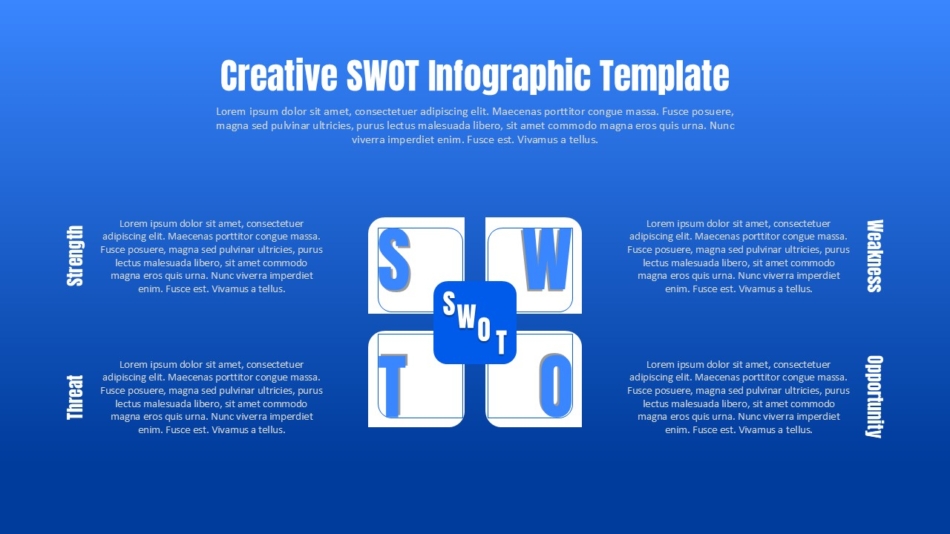
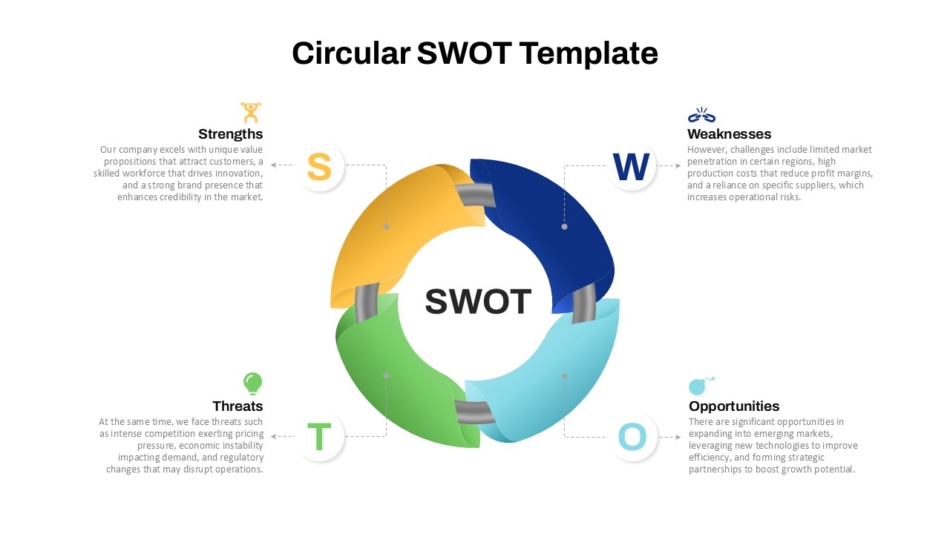
All SlideKit templates work in both PowerPoint and Google Slides, maintaining formatting across platforms. They’re fully editable, allowing customization to match organizational branding, adjust for specific content needs, or modify layouts for particular presentation contexts.
Choosing the Right SWOT Template Format
Different SWOT templates suit different strategic contexts and communication purposes.
Standard Four-Quadrant Layout
The traditional two-by-two grid remains the most recognizable SWOT format. It’s instantly familiar to business audiences, clearly separates the four dimensions, and makes adding content straightforward.
This format works for general business strategy presentations, board meetings, planning sessions, and any context where SWOT familiarity matters. Most audiences can interpret standard SWOT layouts without explanation.
Matrix with Strategy Connections
Some SWOT templates include space for explicitly noting strategic connections between quadrants. These extended formats help teams move from assessment to strategy generation within the same slide structure.
This approach suits strategy development sessions where the goal is generating strategic options rather than just documenting current position.
Circular or Flow-Based Layouts
Alternative visual arrangements present SWOT as interconnected rather than separate. Circular arrangements or flow-based layouts emphasize how factors in different quadrants relate and influence each other.
These formats work when emphasizing the dynamic, interconnected nature of strategic factors or when presenting to audiences who’ve seen standard SWOT layouts repeatedly and appreciate visual variety.
Comparative or Scenario Formats
When comparing multiple SWOTs or showing how SWOT changes under different scenarios, specialized formats that present multiple analyses side by side work better than sequential standard SWOT slides.
These comparative formats suit competitive analysis presentations, scenario planning discussions, or strategic option evaluation where understanding differences between situations drives decisions.
Personal SWOT Analysis Examples
While most SWOT discussion focuses on organizational analysis, the framework applies effectively to personal career development and professional growth planning.
Personal SWOT analysis examples might include strengths like specialized technical skills, industry relationships, or proven track record in specific areas. Weaknesses could be skill gaps, limited experience in desired areas, or geographic constraints. Opportunities might include emerging field growth, organizational restructuring, creating new roles, or industry trends favoring your capabilities. Threats could be automation of current role, credential requirements you don’t meet, or market shifts reducing demand for your skills.
The strategic thinking process remains the same. Leverage strengths to pursue opportunities, address weaknesses that prevent opportunity capture, use strengths to mitigate threats, shore up weaknesses that make threats particularly dangerous.
Personal SWOT analysis particularly helps during career transitions, role changes, or professional development planning where structured self-assessment produces clearer direction than unstructured reflection.
Making SWOT Analysis Actionable
The ultimate test of SWOT quality is whether it drives better strategic decisions. These practices help ensure SWOT analysis produces action rather than just documentation.
Connect Each SWOT Point to Strategic Implications
Don’t just list factors. State what each factor means strategically. If proprietary technology is a strength, what strategies does that enable? If regulatory complexity is a threat, what defensive moves does that require?
Making implications explicit transforms descriptive SWOT into strategic guidance.
Prioritize Based on Strategic Impact
Not all strengths, weaknesses, opportunities, and threats matter equally. Identify which factors have the largest potential strategic impact and deserve most attention in planning.
This prioritization focuses resources on factors that actually matter rather than spreading attention across everything equally.
Assign Ownership for Strategic Responses
Each significant SWOT factor should have someone responsible for the strategic response. Opportunities need owners who develop capture strategies. Threats need owners who develop mitigation plans. Critical weaknesses need owners who develop remediation approaches.
Ownership converts SWOT from passive assessment to active strategic work.
Review and Update Regularly
Build SWOT review into regular planning cycles. Revisit quarterly or when significant changes occur. Update factors as conditions evolve. Track whether assumed strengths prove accurate, whether anticipated opportunities materialize, or whether feared threats develop.
This ongoing review keeps strategic understanding current and tests the quality of strategic assessments over time.
Practical Takeaways
SWOT analysis templates structure strategic assessment of strengths, weaknesses, opportunities, and threats into frameworks that support better decision-making. Good templates maintain the critical distinction between internal factors (strengths and weaknesses) and external factors (opportunities and threats) while providing clear visual organization.
Common mistakes include confusing internal and external factors, writing vague generic points, listing everything instead of prioritizing, failing to connect quadrants strategically, treating SWOT as one-time exercises, and basing assessment on opinion rather than evidence.
Clear SWOT points are specific and concrete, use comparative language for internal factors, focus on impact for external factors, and maintain consistent language throughout.
Creating SWOT analysis works well in PowerPoint and Google Slides using either built-from-scratch approaches or ready-made templates that handle formatting professionally. SlideKit provides multiple SWOT formats including standard layouts, creative visual alternatives, blank customizable frameworks, and specialized formats for comparative analysis or strategy development.
The right SWOT template matches your strategic context, presentation audience, and communication purpose while maintaining the clear four-quadrant structure that makes SWOT thinking valuable. Whether using traditional layouts or visual alternatives, the template should support clear thinking and actionable strategic insights rather than just looking organized.